Mascots – Japan’s Cutest Billion-Dollar Industry
Judged on the kawaii overload, it is easy to underestimate Japan’s mascots.
Looking deeper reveals a ¥2.85 trillion character economy that covers governments, police forces, companies and shopkeepers alike, and is far more serious business than the cute surface suggests.
Your first visit to Shinjuku Station is, to put it mildly, a culture shock. The number of train lines, the crowds, the 100+ exits. And that’s before getting to the Kenketsu-chan vampire mascot outside the blood donation station.
Yes, a cute vampire is waiting for your blood.
Kenketsu-chan is far from alone. She is part of the cutest coven of creatures that inhabit every part of Japan and Japanese life.
Japan’s yuru-chara (ゆるキャラ) — the loose-limbed, endearingly amateurish character mascots that represent rural prefectures, tax offices, blood banks, companies, and even prisons, form one of the country’s most iconic features.
They are a sprawling institutional system for managing local and corporate identity, and they are big, big business.
According to the Yano Research Institute, Japan’s broader kyarakutā bijinesu (character business) — encompassing licensing rights and merchandising across all character types — reached ¥2.78 trillion in FY2024 and is forecast to expand to ¥2.85 trillion in FY2025.
The Deliberate Charm of Imperfection
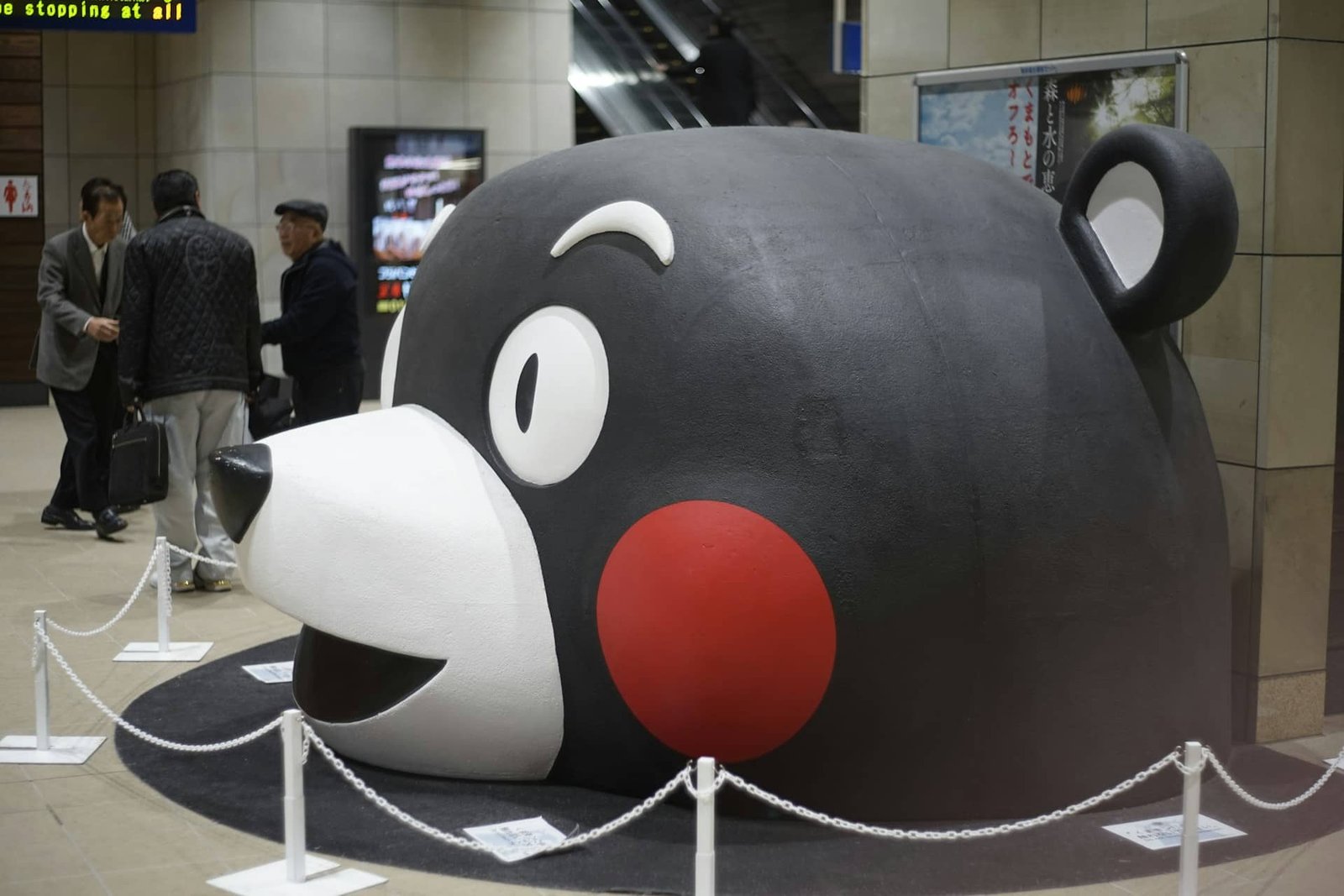
Somewhere in Kumamoto Prefecture, a chubby black bear named Kumamon is busy at work. Not only does he hold dual official civil service titles as “Sales Manager” and “Happiness Manager” for the Kumamoto prefectural government, he is also listed as an employee of the prefectural office, and has generated, by conservative estimate, over ¥1.13 trillion in cumulative branded-goods sales across his first decade of service.
Not bad for a bear whose personality is described in official promotional documents as “potentially violent but irresistibly adorable.”
In other words, you probably shouldn’t tell him to his face that he is, by many standards, something of a simple construct, even for yuru-chara.
Yuru (ゆる) means “loose” or “laid-back”; applied to mascot design, it connotes a deliberate, almost philosophical rejection of polish. A yuru-chara is supposed to look like it was designed by someone well-meaning with access to a felt supply, a limited budget, and equally limited talent for sewing. This is not a flaw; it is the entire point.
Of course, not all mascots have a yuru-chara aesthetic, and the likes of Hello Kitty and Pikachu are definitely precision-engineered. However, the yuru-chara aesthetic is a core part of many mascots, in companies and governments alike.
Compressed Mascot Identity
When looking at Japanese mascots, you will likely notice how they are a compressed encyclopedia of identity.
Take Hikonyan, the cat mascot of Hikone City in Shiga Prefecture, who wears a red samurai helmet. This is a direct reference to the feudal lord Ii Naotaka and the local legend of a cat who saved him from a lightning strike.
Bunkakki from Hiroshima is designed to resemble an oyster — the prefecture’s most famous food — with a body tinted blue for the Seto Inland Sea and a maple leaf on its head for the prefecture’s symbol.
Regional Creation Boosts Mascots
The Japanese concept of chihō sōsei (地方創生 — “regional creation” or local revitalization) became formal government policy under the Abe administration in 2014.
Mascots emerged as an informal but remarkably effective instrument of that policy: low-cost, high-visibility community anchors that could attract tourism, merchandise revenue, and media attention to places that otherwise struggled to compete with major urban centers.
The Kumamon case study demonstrates what this model looks like at full scale. Created in 2010 to promote tourism around the opening of the Kyushu Shinkansen extension, Kumamon generated, by the Bank of Japan’s estimate, ¥123–124 billion in economic benefits to the prefecture within just two years of his launch.
The key enabling mechanism: Kumamoto Prefecture offers Kumamon’s usage rights entirely for free, to any individual or business, as long as the products promote Kumamoto goods or services.
Beyond City Hall
Move beyond the prefectural level and the mascots are still everywhere. Nobody knows how many mascots Japan has. Estimates run from “several hundred” (NHK, 2008) to more than 3,000 entries in one fan-built catalogue (2014), and a 2021 survey counted 1,553 characters from local governments alone. What the numbers do show is reach — and the examples show just how far across society you will find mascots.
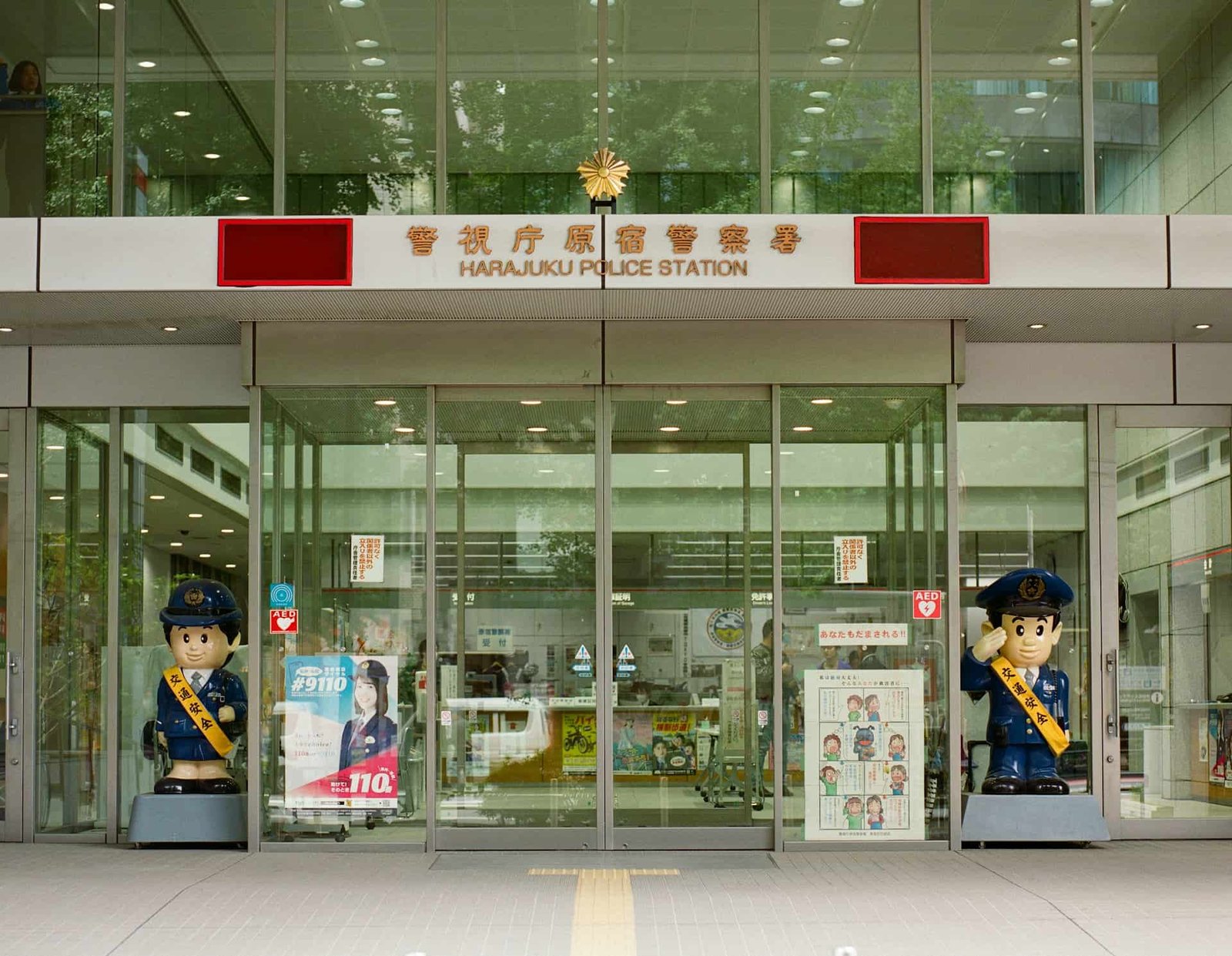
All 47 prefectural police forces have a mascot of their own, among them owls, horses, ducks and deer. The defense ministry unveiled Prince Pickles in 2007. A prison in Asahikawa launched Katakkuri-chan in 2013. Kobe City alone has 42 mascots, covering recycling, smoking manners and friendliness.
Companies have mascots too. Fujiya has Peko-chan, Fuji TV has Gachapin and Mook, Yanmar has Yan Bo Ma Bo, Aflac Japan has its duck, Kewpie has the Kewpie doll, and Mister Donut has Pon de Lion. JR East’s Suica train card has a penguin, and even the Ponta loyalty-card scheme has a mascot of its own.
A Social Habit, Not Just a Policy
The system also runs on people. Mascots need bodies, and the performers inside the kigurumi costumes meet, hug and pose for photos; there is even a school that trains them.
Crowds follow. The Hikone Yuru-Chara Festival drew 75,000 fans at its third edition, nearly double the first in 2008, and the Yuru-Chara Grand Prix drew more than 23,000 attendees in 2017. Author Matt Alt calls them “working characters”: they have a job to do, and they appeal across gender and age groups.
The explanations people reach for are closer to religion than marketing. Hiroyuki Aihara, founder of a mascot-focused institute that belongs to Bandai, ties the habit to ancient belief and Japan’s countless deities. Hosei University professor Sadashige Aoki calls mascots “little deities” that comfort a society stressed by everyday life, which helps explain why a blood bank, a police force and a train card can all end up with one.
The Maturation of Mascot IP
Perhaps the clearest signal that Japan’s mascot culture has crossed from charming folk tradition into full institutional seriousness is the emergence of contested trademark law around mascot characters. In March 2025, Japan’s Intellectual Property High Court issued a ruling in a case involving Ponchan (ぽんちゃん), a local government-linked mascot, that rescinded a Japan Patent Office decision which had treated the mascot’s nickname as “famous” under trademark law.
The court’s detailed reasoning addressed what “famousness” actually requires in the context of character IP — including the geographic scope of recognition and the nature of the managing organization’s licensing and social media operations.
The ruling matters because it reveals how municipalities now operate mascots: not as informal tourism props, but as managed IP assets, with licensing agreements, social media strategies, and trademark registrations to protect. The question of who owns a regional mascot — and what protections that ownership confers — has become a live legal question rather than an academic one.
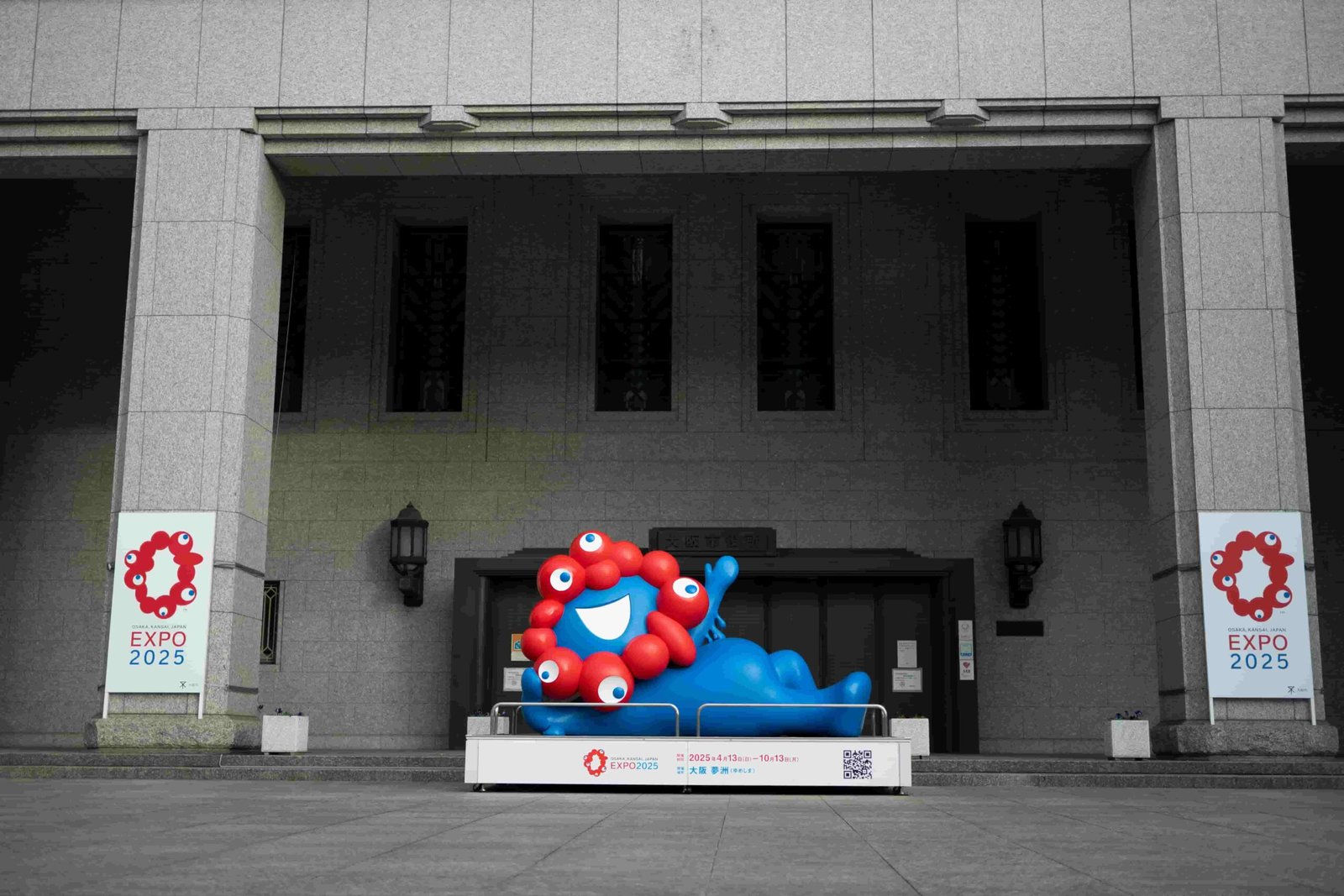
The Osaka Expo 2025 mascot, Myaku-Myaku — a surreal organism of cells and water selected from 1,898 design submissions and named in a national contest drawing over 30,000 entries — illustrates how event mascots now operate at the apex of the mascot commercialization system. By early April 2024, more than a year before the Expo opened, Myaku-Myaku had already secured 107 official licensing partners, approximately 800 products on the market, six permanent retail stores across Tokyo, Osaka, and Kyoto, dedicated train wraps on the JR West Osaka Loop Line and on Tōkaidō-San’yō Shinkansen services, and a specially painted JAL aircraft.
From a vampire at Shinjuku Station to a cellular organism on a Shinkansen, Japan has settled on a simple rule: almost anything, whether a prefecture, a police force, a blood bank or a train card, is easier to love when it comes with a face. The felt costumes and wonky proportions are the point, and the money is just what happens when a whole country takes that idea seriously.
Photos: