Why Japanese TV Shows Love “Reaction Windows”
Reaction windows are a staple on many Japanese TV shows.
Spend some time with the “Nihon Googlebox” and the reactions – and reactors – become quite familiar.
My first day in Japan was a surreal, jetlagged blur that would make for a Snatch-style journey sequence.
Trains from Narita Airport to Tokyo Station, to Yokohama Central, to Fujizawa and on to Yamato. Into a taxi, through 20 minutes of non-descript Japanese town, drop off another English teacher, five more minutes in taxi, final stop is me, and into Leo Palace 18 square-metre apartment.
Explore the living quarter equivalent to a cardboard box with plumbing, spin around, spot the TV, find the Japanese language remote, click everything until the TV turns on.
It is 10:30 a.m., and a cooking show is in full swing. A chef is tending to a steak, the sizzling meat framed by small, floating bubbles in each corner containing images of someone reacting in real time. They seemed thrilled by the steak. I can tell, because three of them look like they are foodgasming…lewdly. The fourth reactor is a little harder to decipher. This is because he or she is dressed in a full Mexican wrestler mask and outfit. At this, my brain short-circuits.
It is years until I dare switch on a Japanese TV again. The reasoning: If this is what happens at 10:30 a.m., I feel in no way equipped to deal with what sensory assaults await in evening shows.
These days, a bottle of wine or sake and an evening of Japanese TV have become a guilty pleasure for my wife and me when we travel around Japan.
And I have become more familiar with the “wipe” – one of the names used for the reaction windows that are ubiquitous in Japanese TV shows.
The ubiquity of the “wipe”
In Japanese TV production, the reaction window is called a waipu (Janglish for “wipe”), and it is as common as commercials.
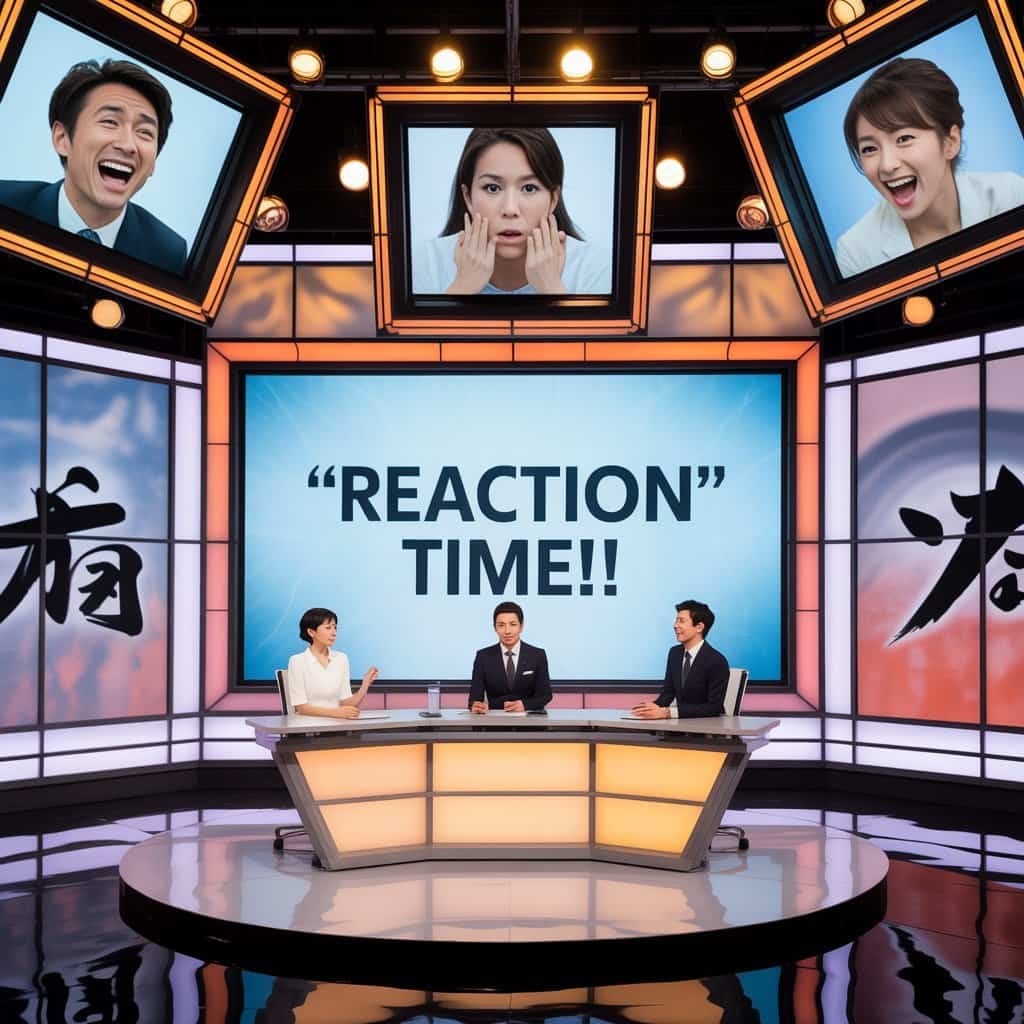
Whether you are watching a variety show, travel program, quiz segment, or cooking competition, you will see someone’s face in the corner, reacting to whatever is happening on the show.
These reactors are almost always talento (a catch-all category for Japanese celebrities), many of whom feature in several shows – sometimes even in an evening’s TV entertainment programming.
The waipu dates back to the early 1980s and the hit talk show Naruhodo! THE WORLD, which began cutting to celebrities reacting to pre-recorded video segments.
Producers had previously relied on audio reactions but discovered that viewers responded strongly to seeing familiar faces simultaneously with surprising or funny moments happening in the show.
Since then, the waipu has spread across genres, with often exaggerated reactions becoming part of the entertainment.
Top five reactions of Japanese TV shows
Some reactions are so common that they have become part of the language of television itself. A quick top five of Japanese TV shows would include:
- “Oishii!” or “Umai!” – The go-to declarations of deliciousness, delivered with foodgasm-face to anything from a Michelin-starred meal or a convenience store sandwich (the latter are, admittedly, amazing).
- “Heeehhh?!” – The Japanese catch-all sound that covers feelings of surprise, admiration, disbelief, amazement, confusion, and more. The type of feeling expressed depends on tone and facial expression.
- Over-the-top shock face – Eyes widened, mouth agape, hands clutching the cheeks. Often paired with sound effects and dramatic zoom-ins for maximum impact.
- The knowing nod – The slow, sage signal of agreement or understanding. Can sometimes be inserted in editing to make a celebrity seem engaged even if they weren’t speaking (or paying attention).
- Hand-over-mouth giggle – Common among female tarento, it conveys a mix of modesty, surprise, and amusement all at once. All of it modified to an “appropriate” level (this kind of behaviour drives me nuts).
Why Japanese TV shows love reaction windows
The popularity of reaction windows (and in-studio reactions in general) can be tied to a range of overlapping cultural reasons:
- Cueing the audience – In the same way a laugh track tells you when something is funny, the wipe can signal how you “should” feel about a moment. In a culture with a strong group focus, this “helps” the audience.
- Community – As is the case with YouTube reaction videos, the reaction window can build a sense of community where the viewer and the in-studio talent are watching the show and individual segments together.
- Celebrity marketing – Putting a popular face in the corner gives casual viewers one more reason to stop channel-surfing. Even if they’re indifferent to the main segment, they might stick around for their favourite tarento.
- Tradition and industry norms – Japanese TV production is intensely iterative (a nice way to call it copycat, some would perhaps say). If a format works for one show, it’s adopted across the board.
- Accessibility – For viewers who struggle to follow the dialogue, facial expressions can help convey tone and emotion, especially alongside the colourful on-screen captions that are another hallmark of Japanese TV.
Behind the scenes, there’s also a contractual element: agencies representing tarento often stipulate a minimum number of on-screen appearances. Reaction shots are an easy way to meet that quota without cutting the main footage.
The waipu mixed feelings
To some viewers—Japanese and foreign alike—the wipe is comforting. It creates a shared emotional space, a sense that “we’re all in on this together.” Others see it as another manifestation of Japan’s social pressure to conform.
There’s also the criticism that the wipe can be creatively lazy. Some producers use it as filler to pad out a low-budget segment. In general, Western audiences will likely find that Japanese TV shows could do with being edited down a bit.
Still, its power to guide attention is undeniable, particularly in an era when many viewers are multitasking.
However, the situation is changing, as view preferences and experiences evolve. For example, streaming platforms like Netflix have introduced younger Japanese viewers to content without constant reaction cues, and some find the wipe dated or patronising.
On social media, you can find posts complaining that the effect clutters the screen or treats the audience like they need emotional training wheels.
The wipe may never win over everyone. But its survival for more than 40 years suggests it’s doing something right for Japanese TV’s core audience: guiding emotions, spotlighting celebrities, and keeping viewers engaged through a blend of familiarity, tradition, and marketing logic.
Personally, a tiny part of me is drawn to Japanese TV shows by the wonder if this will be the night I see the return of the Mexican wrestler. So far, no luck. However, they never fail to make me go “heeeehhh?!?!” about something.
Photo credits: Photos for this article were created using the Rene and Ideogram AI image generators.