Know Your Eki: What you Might Miss in Japan’s Train Stations
Japan has more train stations than some countries have towns.
First-time visitors might miss some of the features and details hiding in plain sight that make Japanese railway stops unique experiences.
The very first time I made my way through a Japanese train station, I encountered a station attendant doing some cleaning. The cleaning in question was the bannisters along the stairs leading up to the platform. And he was cleaning them with a feather duster.
Such attention to detail and cleanliness are among the many reasons why Japanese train stations are truly unique.
But making your way along the stations, especially early on in a visit to Japan, can feel like you are missing something. Everyone around you seems to know an instruction manual that was never translated into your language.
The reason is that Japanese train stations (eki, 駅) are not simply places where trains stop. They are layered systems that reward visitors who know what to look for.
The ever-present train stations
Japan has over 8,500 railway stations across a rail network stretching more than 30,000 kilometres. In Tokyo alone, there are more than 800 stations. The number still fails to encapsulate how thoroughly rail has colonised the city’s geography.
In Tokyo, the name of your neighbourhood is largely determined by which station you live near. Shopping invariably takes place close to the stations, and real estate prices are largely determined by your proximity to one.
Then there is the frequency of train travel. Between 45 and 46 of the world’s 50 busiest train stations are Japanese. The top ten are all Japanese. Shinjuku Station, the undisputed champion, serves over three million passengers daily. As a semi-Dane, it puts it into context that the country’s entire population walks through the station in less than two days. Many of them would probably end up stranded inside it, trying to navigate among its 200 exits.
The numbers will also astonish most where the number of employees is considered. Yes, we have the white-gloved station attendants. And yes, they do shove people in during busier periods on some stations.
However, one of the strangest features for foreigners is the little wooden shutters next to the ticket machines outside the gates at the busiest stations. If you have an issue, the little shutter will likely pop open, and you will see that there is a person behind it.
Reading the signs
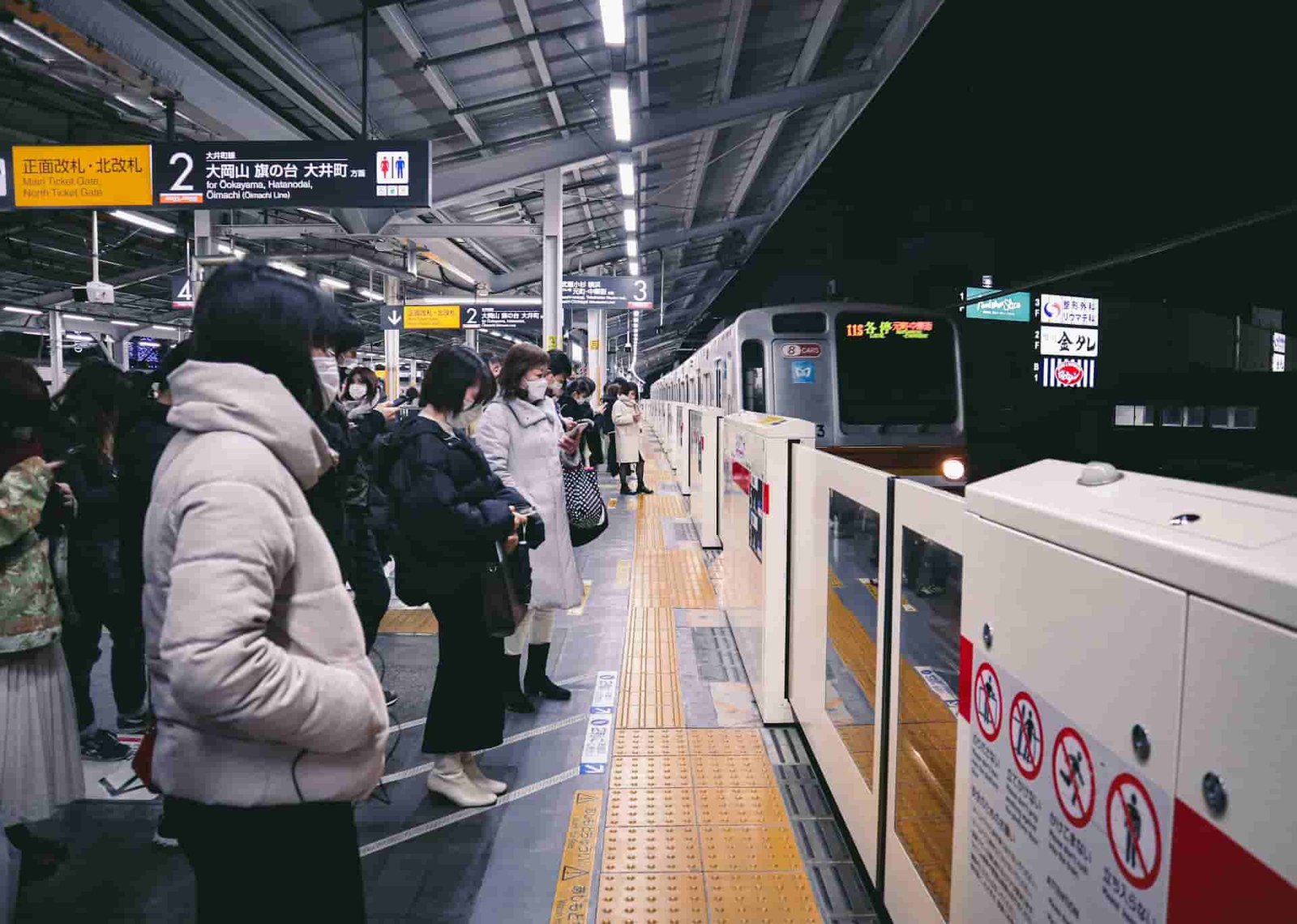
amiliarity with stations is one reason why Japanese people seem to glide through what can appear to foreigners as an impenetrable network.
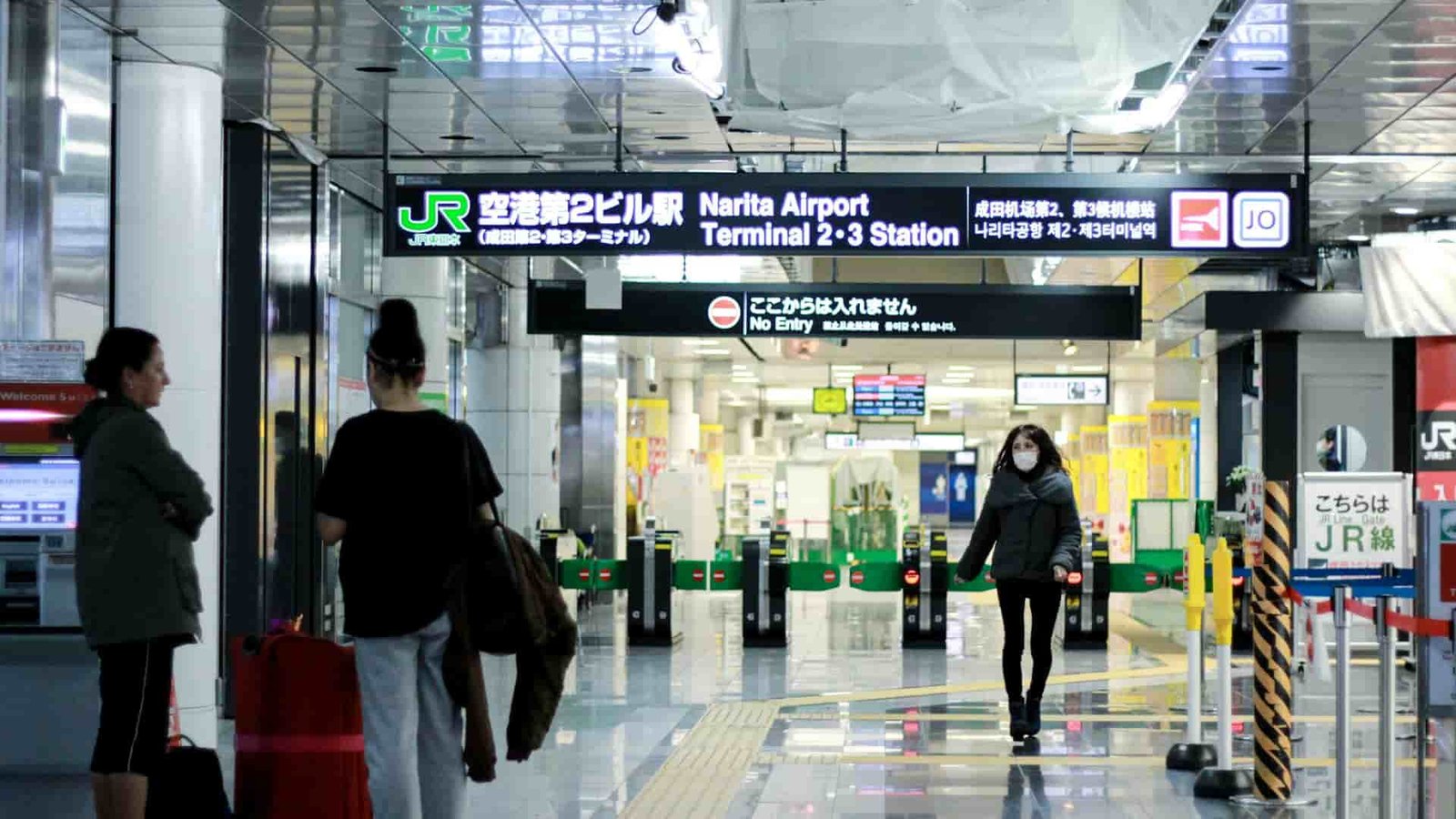
Another reason is the big and small signs that guide you along your journey.
The most obvious is the letters and colours you see everywhere. For example, the Tokyo Metro Ginza Line is G, and the Hanzōmon Line is Z. Each station on that line has a sequential number: Shibuya on the Ginza Line is G-01; Shinjuku-Sanchome is G-11. These codes appear on platform signs, train exteriors, route maps, and station boards.
To stay with the signage, it is formally classified by government regulators into four types: guidance signs, location signs, information signs, and regulatory signs. These are delivered through visual, tactile, audio, and digital channels.
One example of this is the rows of yellow tiles with either raised dots or raised parallel ridges running across pavements, station floors, and platforms throughout the country. Most visitors recognise that they relate to accessibility. Far fewer know what each pattern actually means.
The tiles are officially known as tenji buroku(点字ブロック, literally “braille blocks”), though the name is slightly misleading; they function through foot-feel and vision rather than finger-reading. The two patterns are distinct by design: the dotted tiles are warning blocks, indicating a hazard ahead — a platform edge, a crossing, a staircase. The striped tiles are guidance blocks, forming continuous paths that lead toward exits, gates, or key facilities.
The get-on, we’re leaving melodies
Sound also plays a huge role in Japanese stations. For example, a melody will play when a train is about to pull into a station, or when it is about to leave.
The hassha merodi(発車メロディ, departure melody), orekimero(駅メロ) in the shorthand used by enthusiasts, is an auditory cue. In many cases, it also informs you of where you are, as many stations have their own melodies, often with neighbourhood connections, For example, Takadanobaba on the Yamanote Line plays the Astro Boytheme because the show’s fictional birthplace is nearby and the production company was based in the area; Ebisu plays the theme from The Third Man in a nod to the Yebisu Beer brewery that once stood nearby.
The 乗りものニュース transport outlet has documented how recent years have seen an acceleration toward J-POP and commercially licensed tracks — a drift from bespoke acoustic engineering toward brand partnership that has prompted some nostalgia for the original synthesiser-and-harp era.
Life inside the gates
March 2026 saw the sad end of a much-loved ramen restaurant at Nishiarai Station in Tokyo. One of its defining features was that this restaurant wasn’t just inside the station ticket gates; it was on the platform itself.
This is far from unique, as the space within stations and on platforms in Japanese train stations are living spaces in ways that are unusual to many foreigners. Slight aside: for me, T’s Tan Tan (fantastic vegan ramen) is a must-stop if I have time when passing through Tokyo Station.
In Japanese, the space is called ekinaka (エキナカ), meaning “inside the station,” and in major hubs it operates as a full shopping and dining district that happens to require a valid fare to access bakeries, prepared foods, speciality tea, stationery, seasonal gift sets — you name it.
The broader ekinaka concept extends beyond food and retail. Major stations contain co-working spaces, medical clinics, pharmacies, childcare facilities, luggage forwarding services, and coin lockers in multiple sizes. The coin lockers (koin rokkā, コインロッカー) in particular deserve attention: they are a logistics solution as much as a convenience, sized from small (A4 documents, one bag) to large enough for full suitcases, increasingly accepting IC card payment, and searchable by availability via third-party apps.
The thousands of lost umbrellas
Given the size and complexity of some stations, you can easily be forgiven for losing your way – or parts of your luggage. If it were the latter, you are in good hands and company. JR East alone handles approximately 2.2 million lost items every year.
When an item is found on a train or platform, it enters a structured chain. Items are held at the station or terminus, logged into a centralised database, tagged, and transferred to a regional lost property office within roughly a week before passing to the police. The wasuremono (忘れ物), literally “forgotten things,” a word with no clean equivalent in English, is tracked, categorised, and kept for up to three months. About 30% of items are ultimately returned to their owners, a figure that sounds modest until you consider the volume and the logistics involved. For mobile phones specifically, the return rate in Tokyo is reported at approximately 83%.
Since 2023, around 30 organisations, including major Tokyo rail operators and Haneda Airport, have adopted an AI-powered matching system. Staff photograph found items with a tablet; the system catalogues colour, shape, and distinguishing features. Keio Railway has reportedly tripled its return rate since adopting the technology.
The point, however, is not the technology. It is the underlying institutional premise: lost property is a service category, with dedicated infrastructure, defined procedures, and measurable outcomes.
The same could be said of many other aspects of Japanese train stations.
Photos: